
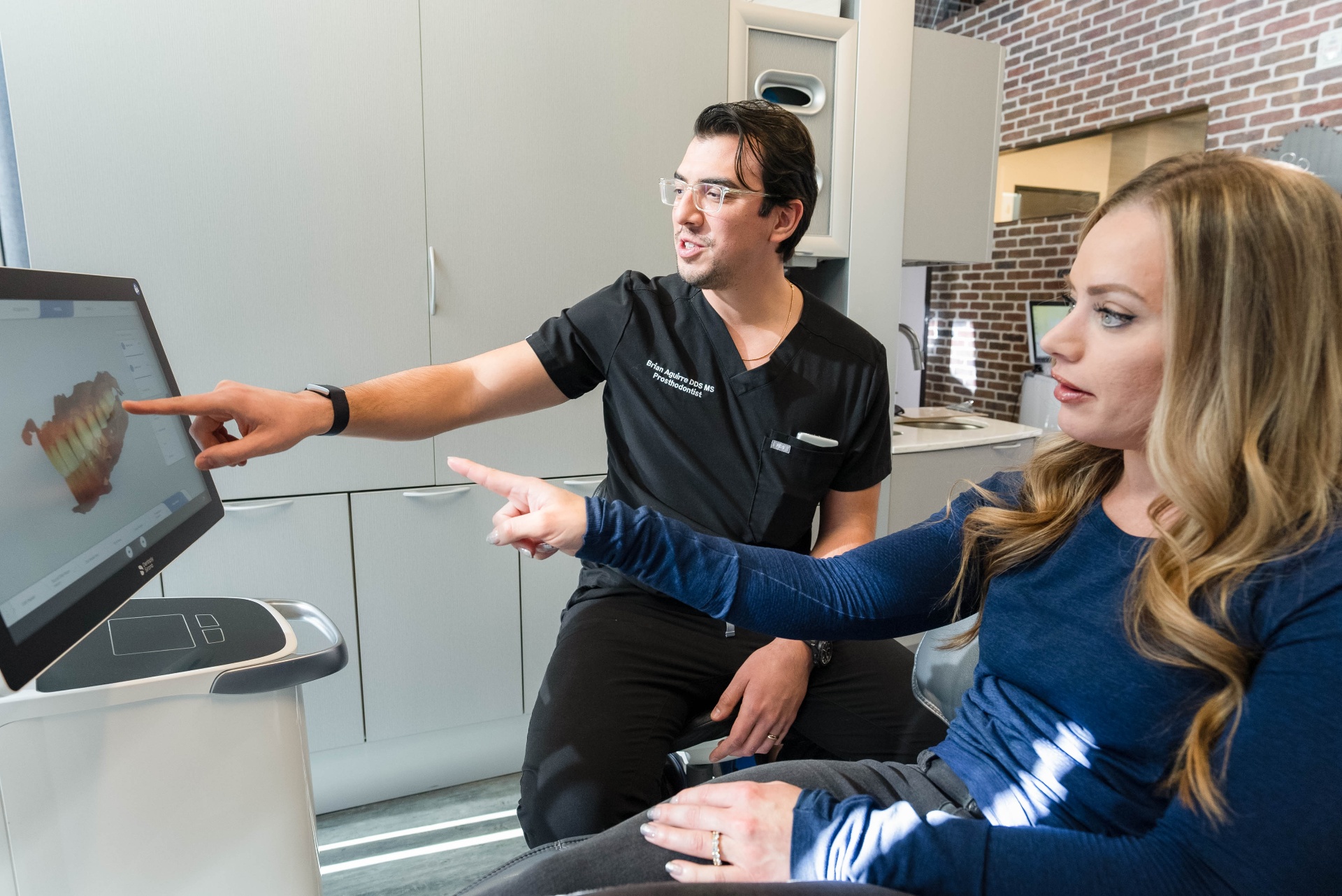
A prosthodontist is a dental specialist who completes three or more years of advanced training beyond dental school in the restoration and replacement of teeth. See a prosthodontist instead of a general dentist when you're missing one or more teeth, considering dental implants or dentures, have failing or complex dental work, or need a full-mouth restoration.
What Is a Prosthodontist?
A prosthodontist is a dentist who specializes in restoring and replacing teeth. After four years of dental school, prosthodontists complete an additional three or more years of accredited specialty training — making prosthodontics one of the American Dental Association's recognized dental specialties.
That extra training focuses on the most complex restorative cases: dental implants, crowns, bridges, full and partial dentures, implant-supported teeth, veneers, and full-mouth rehabilitation. Where a general dentist handles routine care — cleanings, fillings, and everyday checkups — a prosthodontist is the specialist you see when teeth are missing, worn down, or need to be rebuilt.
What Does a Prosthodontist Do?
Prosthodontists plan, design, and place the restorations that rebuild a smile, including:
- Dental implants — titanium tooth roots that support crowns, bridges, or full arches
- Crowns and bridges — caps and fixed replacements that restore damaged or missing teeth
- Dentures — full and partial dentures, including implant-supported and All-on-4 options
- Full-mouth rehabilitation — rebuilding every tooth in the mouth when wear, damage, or missing teeth affect the entire bite
- Veneers and cosmetic restorations — improving the shape, color, and symmetry of visible teeth
At Restorative Dentistry Group, our prosthodontists also design and produce restorations in our own in-house dental laboratory, which means tighter quality control and faster turnaround on crowns, bridges, and dentures.
Prosthodontist vs. General Dentist: What's the Difference?
Every prosthodontist starts as a general dentist — the difference is the additional training and what each does day to day:
| General Dentist | Prosthodontist |
|---|---|
| Four years of dental school | Dental school plus 3+ years of specialty residency in prosthodontics |
| Routine care: exams, cleanings, fillings, simple restorations | Complex care: implants, dentures, full-mouth reconstruction, esthetic makeovers |
| Treats the whole family for everyday needs | Receives referrals for the most difficult restorative cases |
| Coordinates your ongoing preventive care | Plans and delivers the definitive solution for missing or failing teeth |
The two roles work together. Most patients keep seeing a general dentist for routine care, and that dentist refers them to a prosthodontist when the treatment plan involves replacing or rebuilding teeth.
When Should You See a Prosthodontist Instead of a General Dentist?
Consider scheduling with a prosthodontist if any of these apply to you:
- You're missing one or more teeth. Whether you've lost a tooth to decay, gum disease, or injury, a prosthodontist can restore it with an implant, bridge, or denture.
- You're considering dental implants. Implant planning — placement, the restoration on top, and how it all fits your bite — is core prosthodontic specialty work.
- Your dentures are loose, broken, or uncomfortable. A prosthodontist can reline, remake, or upgrade you to implant-supported dentures like All-on-4.
- Multiple teeth are worn, cracked, or failing. When several problems exist at once, a prosthodontist builds one coordinated treatment plan instead of fixing teeth one at a time.
- Previous dental work keeps failing. Repeated crown or bridge failures often point to a bite or design issue that specialty training is built to solve.
- You want a full smile makeover with restorations. Veneers, crowns, and whitening combined into one plan are safest in the hands of a specialist.
- Your general dentist referred you. Many dentists send complex restorative cases to a prosthodontist — that referral is a sign you need specialist-level care.
What Training Does a Prosthodontist Have?
Prosthodontists complete four years of dental school, then an additional three or more years in an accredited prosthodontics residency. During that residency they train in implant dentistry, digital dentistry, dental materials, bite function, and the esthetics of the smile — treating complex cases under specialist supervision before entering practice. It's the same ADA-recognized specialty pathway behind the restoration of millions of smiles each year.
Why Patients Choose Restorative Dentistry Group
Restorative Dentistry Group is a team of prosthodontists serving Colorado from six convenient locations — Denver (Broomfield), Boulder, Brighton, Longmont, Cherry Creek, and Castle Rock. For over 12 years, our specialists have transformed more than 85,000 smiles, supported by our own in-house dental laboratory.
Your first visit is a free consultation: a comprehensive conversation with one of our prosthodontists about your goals, your options, and a personalized treatment plan — with no referral needed.
Frequently Asked Questions
What is a prosthodontist, in simple terms?
A prosthodontist is a dentist who specializes in restoring and replacing teeth — the dentist dentists send you to for implants, crowns, bridges, dentures, and full-mouth reconstruction. They complete three or more years of extra training beyond dental school.
Do prosthodontists do cleanings and fillings?
Most prosthodontists focus on complex restorative care rather than routine hygiene visits. Many patients keep their general dentist for cleanings and see a prosthodontist for the specialized treatment plan.
What's the difference between a prosthodontist and an oral surgeon?
An oral surgeon performs surgical procedures, including some implant placements. A prosthodontist plans and builds the teeth that go on top of those implants — crowns, bridges, and full arches — and designs the complete restoration around your bite and smile.
Do I need a referral to see a prosthodontist?
No. At Restorative Dentistry Group you can request a free consultation directly — no referral required. If you have a general dentist, we're happy to coordinate your care with them.
How much does a prosthodontist consultation cost?
At Restorative Dentistry Group, your first consultation is free. Treatment costs depend on your specific plan; we offer flexible payment options and will review everything with you before any work begins.
Where can I find a prosthodontist near me in Colorado?
Restorative Dentistry Group has six Colorado locations: Denver (Broomfield), Boulder, Brighton, Longmont, Cherry Creek, and Castle Rock. Every office is staffed by prosthodontists and supported by our in-house dental laboratory.